We were then told to afterwards, create an evaluation of our finished work, analysing where we went wrong, what went well, how much time we spent, etc. In my opinion, I enjoyed it all.
Showing posts with label Preliminary Task. Show all posts
Showing posts with label Preliminary Task. Show all posts
Thursday, 6 November 2014
Preliminary Task: Evaluation
In a small group of three; me, Lizzie Stafford and Millie Holmes, worked together to create a small video that was about two minutes long at max, we named it, La Penna Rosa Rojo, we had a change in the name sue to us not being able to find a pen that was actually pink like we had hoped to use within our video. Instead, we used a red pencil (even though it can't be seen so easily in the black and white video, so much time spent for nothing on trying to find the right coloured pencil part) but we still enjoyed spending time on this task. Lizzie did well with the filming as she took pretty much care of all the filming whilst me and Millie prepared rooms, well tried to, and also found out equipment that needed carrying, as well as acting in the video. Below is a link to the video as each of us had a specific job to do on this video and I think we worked well together.
We were then told to afterwards, create an evaluation of our finished work, analysing where we went wrong, what went well, how much time we spent, etc. In my opinion, I enjoyed it all.
We were then told to afterwards, create an evaluation of our finished work, analysing where we went wrong, what went well, how much time we spent, etc. In my opinion, I enjoyed it all.

Wednesday, 5 November 2014
Preliminary Task: Post Production in Utopia

They edited in the colours after shooting as they shoot the scenes in Britain and the blue skies in the scenes are seen, it would be obvious that they have edited in the blues skies, after all, Britain isn't really the place where blue skies are always present.
They use green screens a lot which allows them to add on a background and make out the characters are in a complete different place to where they actually are, fooling the audience.
Tuesday, 4 November 2014
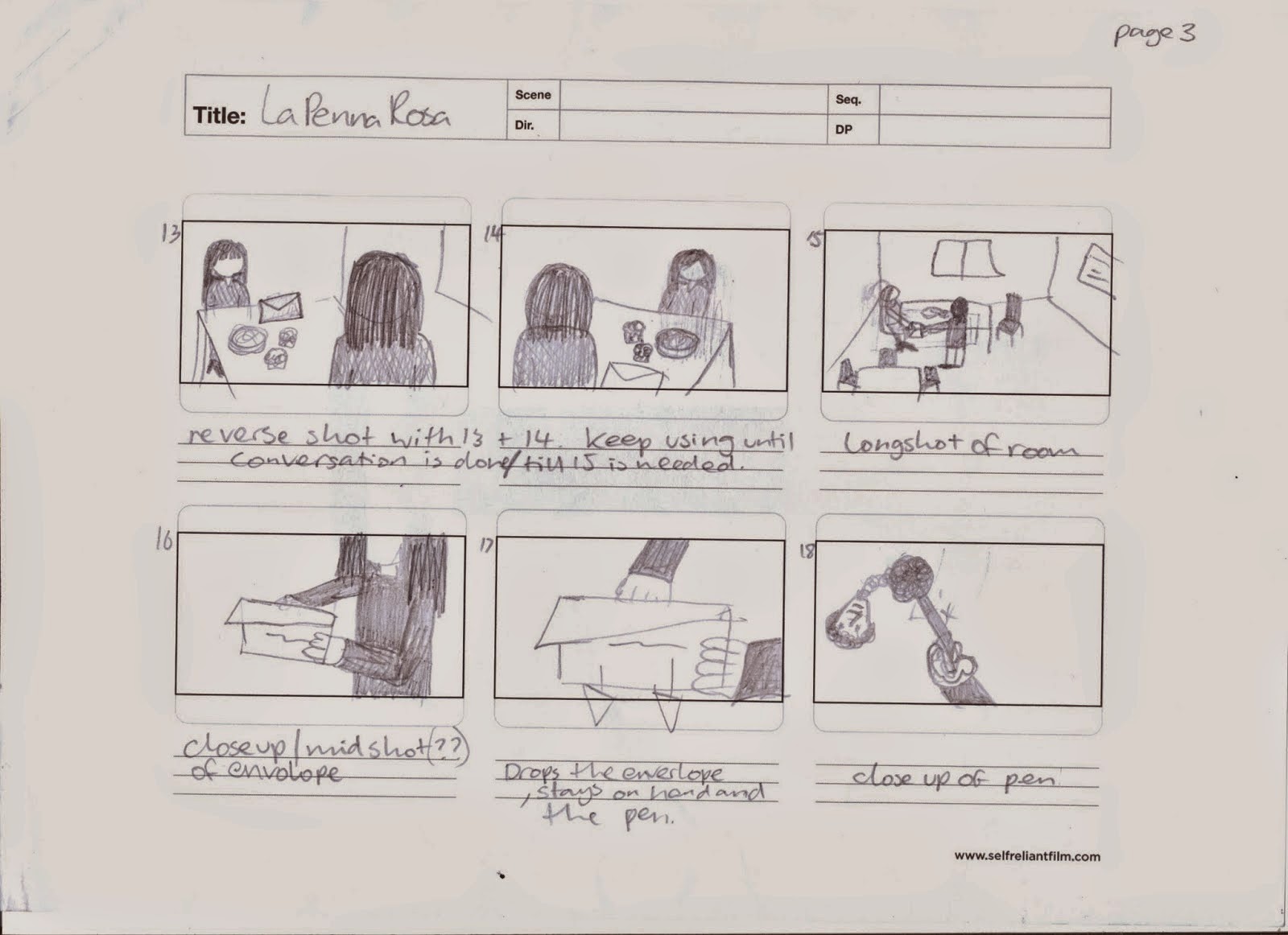
Preliminary Task: Storyboard
This here is a storyboard, created by Lizzie Stafford, a member of our small group, as the title at the time was 'La Penna Rosa'. I'm unsure if we changed it at any point as we switched to using a red pencil instead of the desired pink pen that we wanted for the video... yes... it's serious. Anyway, below is the storyboard we followed, most of the way, for the video.



Preliminary Task/Theory: TV Drama Case Study

In our own time, we were told to produce a presentation that told us in depth about the series we decided to look at. In this case, I decided to look at the medical American TV drama called House as I enjoyed the series thoroughly. Below is the case study I had produced on the series:
Thursday, 9 October 2014
Preliminary Task: Explanation of Task and Different Camera Shots
As our starting task, we are recording a small piece of a character opening a door, crossing a room and sitting down in a chair opposite another character, with whom she (in our case) then exchanges a couple of lines of dialogue. This task will demonstrate match on action shot, shot/reverse shot and the 180 degree rule.
Below are the definitions of the three terms which I will end up looking back on to help with revision.
Match on Action Shot
The match on action shot will emphasise certain events within our clip which will make it stand out more. Match on action (or cutting on action) is an editing technique for continuity editing in which one shot cuts to another shot portraying the action of the subject in the first shot. This is not a graphic match or match cut, it portrays a continuous sense of the same action rather than matching two separate things.
Shot/Reverse Shot
Shot reverse shot is a continuity editing technique used in conversations or simply characters looking at each other or objects. A shot showing what the character is supposedly looking at (either a point of view or over the shoulder shot) is followed by a reverse angle shot of the character themselves looking at it, or of the other character looking back at them, for example.
The 180 Degree Rule
The 180° rule is a filming guideline that participants in a scene should have the same left-right relationship to each other, with filming only taking place within the 180° angle in which this is maintained in a conversation, for example. This allows the audience to have a greater sense of location in the scene in terms of what may be off-screen in some shots, for example in shot reverse shots.
Below are the definitions of the three terms which I will end up looking back on to help with revision.
Match on Action Shot
The match on action shot will emphasise certain events within our clip which will make it stand out more. Match on action (or cutting on action) is an editing technique for continuity editing in which one shot cuts to another shot portraying the action of the subject in the first shot. This is not a graphic match or match cut, it portrays a continuous sense of the same action rather than matching two separate things.
Shot/Reverse Shot
Shot reverse shot is a continuity editing technique used in conversations or simply characters looking at each other or objects. A shot showing what the character is supposedly looking at (either a point of view or over the shoulder shot) is followed by a reverse angle shot of the character themselves looking at it, or of the other character looking back at them, for example.
The 180 Degree Rule
The 180° rule is a filming guideline that participants in a scene should have the same left-right relationship to each other, with filming only taking place within the 180° angle in which this is maintained in a conversation, for example. This allows the audience to have a greater sense of location in the scene in terms of what may be off-screen in some shots, for example in shot reverse shots.
Tuesday, 23 September 2014
Preliminary Task: Practice shots with a Nikon DSLR D3000
We decided to test out a Nikon DSLR D3000 camera and practiced different shots, giving us a good idea on what we wanted to use later on.


Photos of Millie and Me
Photos taken by Lizzie
Mid-Shot
Establishing Shot
Extreme Close Up
Long Shot using Leading Line
Close Up
Establishing Shot

Low Angled Shot
Three Different Viewpoints from Different Angles
Mid Shot
Long Shot

Photos of Millie and Me
Photos taken by Lizzie
Subscribe to:
Posts (Atom)